
Fabrication & process piping / QATAR
What we deliver
Scope runs from the compressor to the point of use as a turnkey package
Low-pressure distribution networks at 7–10 bar cover the ordinary factory and workshop ring main; high-pressure specialist lines at 20–40 bar and above serve test rigs, air-start systems, pneumatic drilling and process duties. Materials cover galvanised iron, stainless steel in SS304 and SS316L, copper, carbon steel including schedule 80 for higher-pressure duty, PPR, modular aluminium, and specialty alloys such as duplex, Hastelloy, Inconel and titanium where the process demands them. Work is executed to ASME B31.3, QCS 2014 and ASME Section IX welding qualifications, and every project closes with a hydrostatic or pneumatic pressure test and a commissioning report issued with as-built drawings and material certificates.
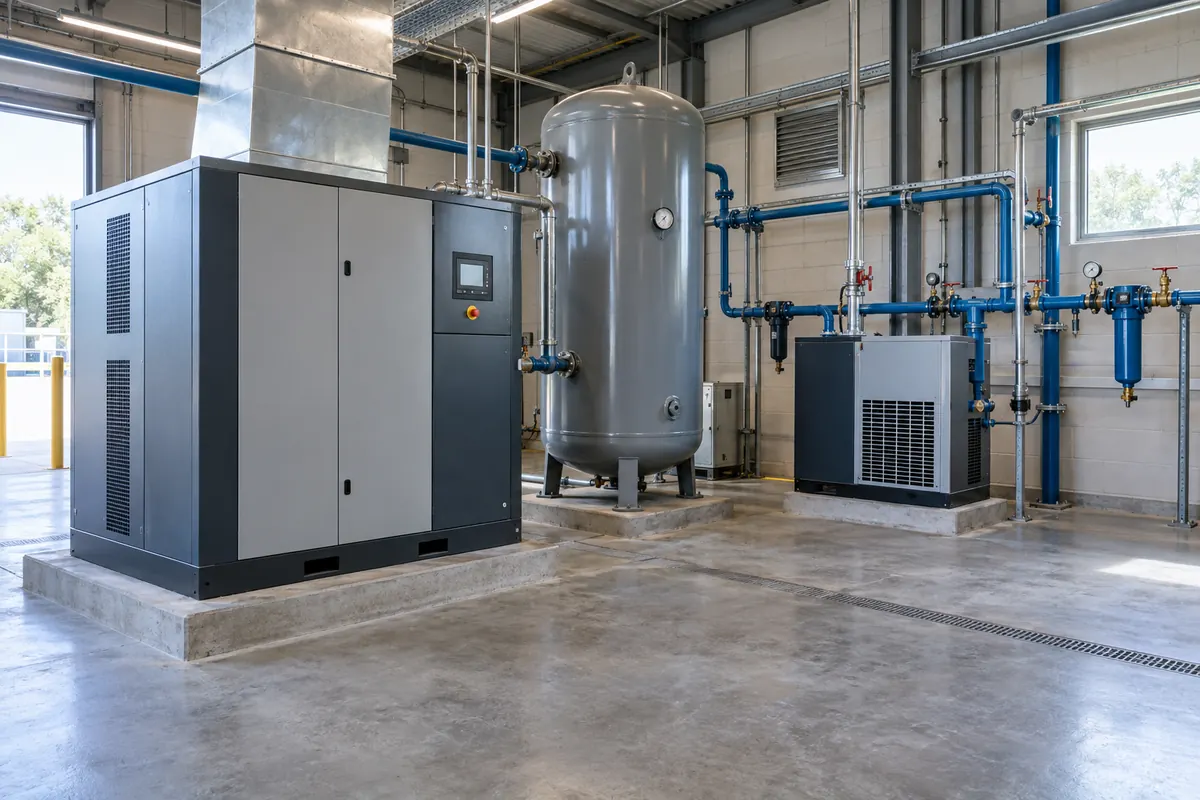
Beyond the pipework itself the division supplies and installs the air-treatment train that determines whether the air arriving at the machine is usable: refrigerated and desiccant dryers, coalescing and activated-carbon filtration to the required ISO 8573-1 class including Class 0 oil-free air, electronic zero-loss drain valves, condensate management and oil-water separators, receivers, valves, fittings and flanges
Engineering services wrap around all of it — piping design and CAD layouts, material specification and consultancy, and flow and pressure auditing of existing installations — supported by an online air pipe size calculator on the division site, which is worth promoting as a lead generator in its own right. Maintenance, retrofitting and 24/7 emergency repair complete the offering.
Sectors served: oil, gas and petrochemicals (instrument air, pneumatic control valves, nitrogen generation), food, beverage and dairy, manufacturing and automotive, pharmaceutical and medical laboratories, electronics and semiconductors, textiles and garments, logistics and warehousing, power generation, aerospace and aviation, mining and mineral processing, and construction and infrastructure
Location coverage already built out on the division site: Doha, Mesaieed Industrial City and Ras Laffan Industrial City in Qatar, and Dubai and Abu Dhabi in the UAE.
Design and sizing
Each installation is designed rather than simply run: compressor FAD and simultaneous demand are established, diversity applied, and pipe sizes selected against an allowable total pressure drop — normally held under 0.1 bar or about three per cent from receiver to the furthest outlet, since roughly every additional bar of pressure costs seven per cent more energy at the compressor. Layouts are built as a ring main wherever the building allows, so air reaches each drop from two directions and demand peaks do not starve the far end. Mains are graded to fall toward drain legs, drops are taken from the top of the main on swan-neck take-offs so condensate cannot be carried into tooling, zone isolation valves are fitted so one cell can be worked on without shutting the plant, and each point of use is finished with a filter-regulator-lubricator, quick couplers, hose reels or retractable drops as required. Scope also covers the compressor-room package: receiver, refrigerant or desiccant dryer, line filtration to the ISO 8573-1 air-quality class the process demands, condensate drains and oil-water separators, and interconnecting pipework.
Installation and components
Pipe is cut square, deburred and chamfered, insertion depth marked and each joint made and checked to the manufacturer’s torque and engagement requirements. Supports and brackets are set at the specified spacing with allowance for thermal expansion, and runs are installed on walls, ceilings, roof steelwork or overhead in workshops, with drops to machines, benches and bays. Fittings supplied and installed include elbows, tees, reducers, unions and flange adapters to existing steel or stainless lines, ball and butterfly valves, manifolds and outlet blocks, wall brackets, quick-release couplings, and connection kits to compressors, dryers and receivers.
Testing, commissioning and handover
Systems are pressure and leak tested at the specified factor above working pressure, purged and blown through, then checked joint by joint with soap solution or ultrasonic detection. Pressure and flow are verified at each outlet under load, valves and drains are set and labelled, pipework is marked with service identification and flow direction, and the client receives an as-built layout or isometric, test records, torque and joint sign-off sheets, and the system warranty.
Retrofit and energy work
Aamtron also replaces existing corroded steel airlines in live plants, working in phases with temporary bypasses and out-of-hours tie-ins so production is not interrupted, and offers standalone compressed-air leak surveys with ultrasonic detection, tagging, repair and a report quantifying the losses in cubic feet per minute and in kilowatt-hours — often the fastest payback available on a factory’s utility bill. Sectors: bottling and beverage plants, food and pharmaceutical manufacturing, automotive workshops, service centres and tyre bays, general manufacturing and fabrication shops, laboratories, and warehouses and logistics facilities.
APPLICATION GUIDE
Where this fits your project
A compressed-air network should deliver the required air quantity and quality at each point of use. Pipe sizing depends on simultaneous demand and pressure loss across the route, rather than compressor pressure alone.
Details to resolve before work begins
Review route lengths, branch positions, future demand and treatment equipment. The scope should address supports, isolation, connection details and testing, with a clear distinction between network installation and compressor or dryer supply.
Plan the connected systems
SecureAir aluminium airline piping ↗ Pneumatic & instrumentation products ↗ Steel & piping materials ↗
Selection & project coordination
The installation is coordinated with site access, adjoining systems and the operating requirements of the facility. Inspection, commissioning and documentation requirements are agreed as part of the project scope.
Questions before you start
Why can equipment receive low pressure when compressor pressure looks normal?
Pressure loss can occur through undersized lines, restrictions, treatment equipment or increased simultaneous demand. Review the network and operating pattern before assuming that a larger compressor is the only solution.
What information is needed to quote for compressed-air & process piping?
Please provide compressor free-air delivery, working pressure, pipe route and length, simultaneous demand and air quality. Include the project location, drawings or equipment schedule, required delivery date and any consultant specification. This helps our team identify the correct scope before pricing.
How is the compressed-air & process piping scope agreed?
The team reviews the drawings and site conditions, identifies interfaces with other trades, and sets out the deliverables and exclusions in a written quotation. Technical submittals, inspection requirements and handover records are agreed to suit the project.
Discuss your Qatar project
Contact Aamtron’s Doha team with the project location, drawings and required programme. For occupied buildings or operating facilities, include access restrictions and permitted work windows. Product availability, delivery timing and the agreed scope are confirmed with the quotation.
Send your requirements ↗